
The celebration of dailyness…
“Tomorrow, and tomorrow, and tomorrow,
Creeps in this petty pace from day to day,
To the last syllable of recorded time;
And all our yesterdays have lighted fools
The way to dusty death. Out, out, brief candle!
Life’s but a walking shadow, a poor player
That struts and frets his hour upon the stage,
And then is heard no more. It is a tale
Told by an idiot, full of sound and fury,
Signifying nothing.”
—William Shakespeare, Macbeth
Nothing but experience can prepare one for the daily grind of any enterprise. Even the most exhilarating profession has its moments of mindless routine. Just ask any first responder, who often endures hours of boredom followed by moments of sheer terror. They will tell you that the unpredictability is what entices them to their work—as well as being the reason for their burnout and fatigue.
Poet Stanley Kunitz was a bit more sanguine about the subject when he wrote, “It is out of the dailiness of life that one is driven into the deepest recesses of the self.” It seems there is a certain drudgery attached to the per diem routine that often militates against the elegance of one’s chosen vocation. We take demonstrable note of it only when we feel particularly stressed or challenged—at those moments when are likely to consider ourselves ill-used. Perhaps we need to pay closer attention.
The truth is, as C. S. Lewis has reminded us, “The future is something which everyone reaches at the rate of 60 minutes an hour, whatever he does, whoever he is.”
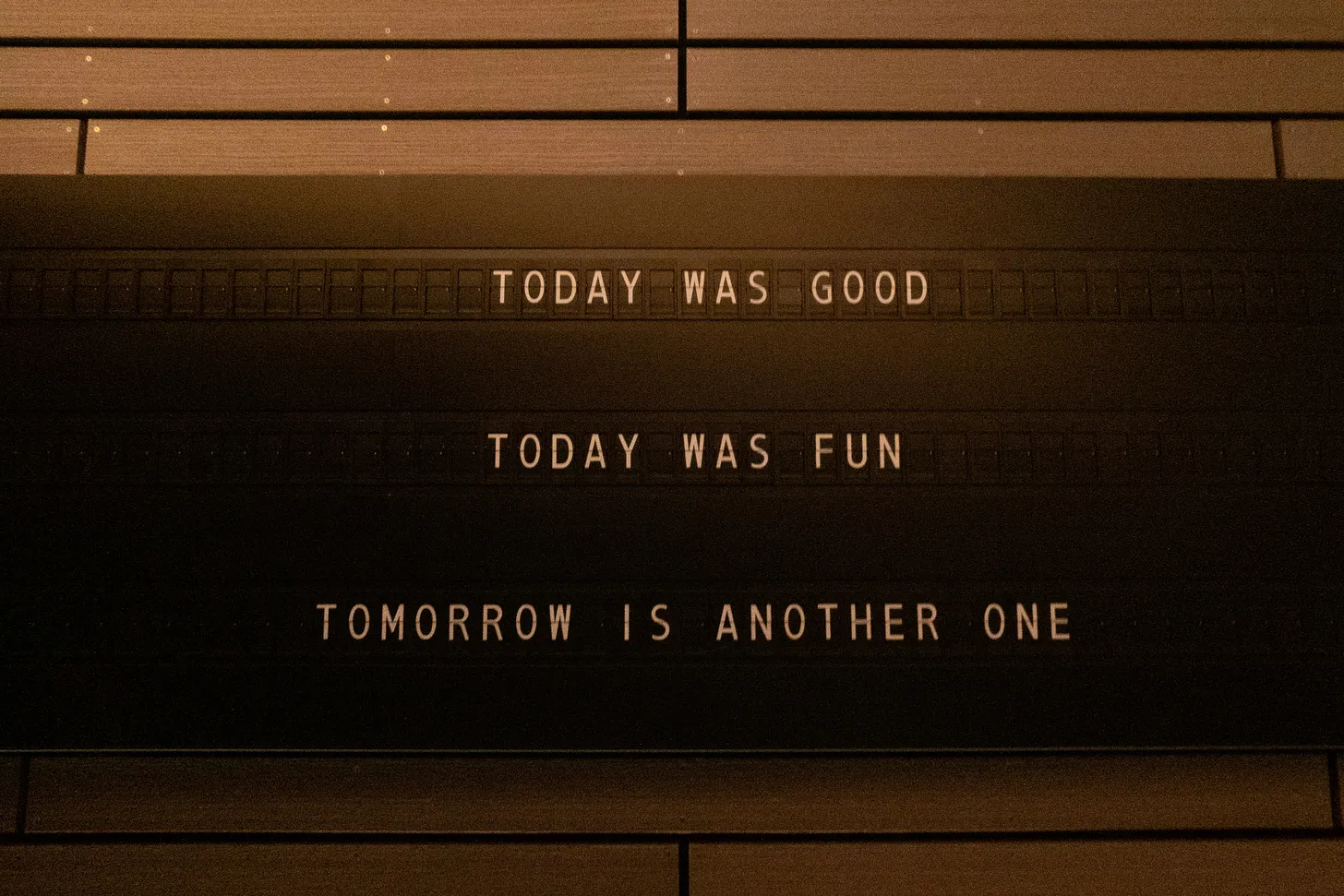
Photo by Nick Fewings on Unsplash
One day follows another in the experience of most of us. and often, there is northing notable transpiring in any given 24-hour period. Right now, in the late autumn, when the days are just beginning to remind us that sunshine does not grace us every day, we might become discouraged by the early nightfall; it will only become more pronounced by the middle of December. We will still be here when winter actually begins, and we will trudge thought the snow to go about our daily business. Most—but not all of us—will make it to the Spring Solstice. And some—but not all of us—will come to realize that the passing of the seasons has nothing to do either with our will or our pleasure.
“All is vanity,” says the Preacher, and so it is. Ultimately, there is a season for everything—the good and the bad. A place and time for all things under the sun. Tempus fugit, whether we like it or not!
In the 21st century—deep into an age of science that has advanced to an understanding of quantum mechanics and particle physics (not for me!), we blithely speak of the space-time continuum. A rudimentary knowledge of black holes might give us some idea of energy and matter folding in on itself. For the first time since Einstein’s Theory of Relativity, the average person is passably familiar with the notion of time that is markedly different from the poetic perspective of the ancient psalmist when he declares, “A thousand ages in thy sight are like an evening gone” (Psalm 90). The elegance of that acknowledgment exceeds the human capacity to grasp unadulterated awe!
In the Western perspective, time is often regarded as a commodity—and a scarce one at that. It is almost as if time itself is devoid of any meaning, apart from its utility. But what if time actually does possess an intrinsic quality that exceeds even its obvious value? What if we were to perceive time as having been infused with meaning since its beginning nearly 14 billion years ago? Indeed, the ancient Hebrews understood that perspective, and the same orientation has been coopted by Christians and Muslims.
As a pastor and worship leader, I am amused by those who appear for worship just before the appointed time has actually begun. The same observation might be made about the worker who shows up at her work station precisely at the moment when her employment clock begins to record. I have a dear friend and colleague who used to say that such behavior was a product of an industrial society wherein we have learned to withhold our work (devotion) until the time clock is activated! I think there is some truth to that.
It is often said that time flies when we are having fun. I always add that it does even if we are not! For Christians, this is the Advent season, and it is a time of expectant waiting based on the experience of the past and the extrapolation that what has already happened will happen again. There was a first coming [of Christ] in the past; there will be another…and another…and another, and so forth…
More to the point, the Prince of Peace has come and will keep coming. And none of it has anything to do with human agency! Meanwhile, we are to find meaning in the dailyness of life—even when it threatens to degenerate into a mind-numbing routine. I suspect it has something to do with the intentional veneration of time as the sacred gift it is.
Thinking Out Loud publishes twice weekly on Substack.com and on WordPress at Shalomista.org. Thank you for supporting my work. Please share these posts widely and consider a subscription. Join the fray with a paid subscription and give me a piece of your mind— or you can always lurk for free! All views expressed are entirely my own and have no connection to any institution of which I might be a member.
 Raising Basileia