The Cloud of Unknowing…

..or what the “bleep” do we know?

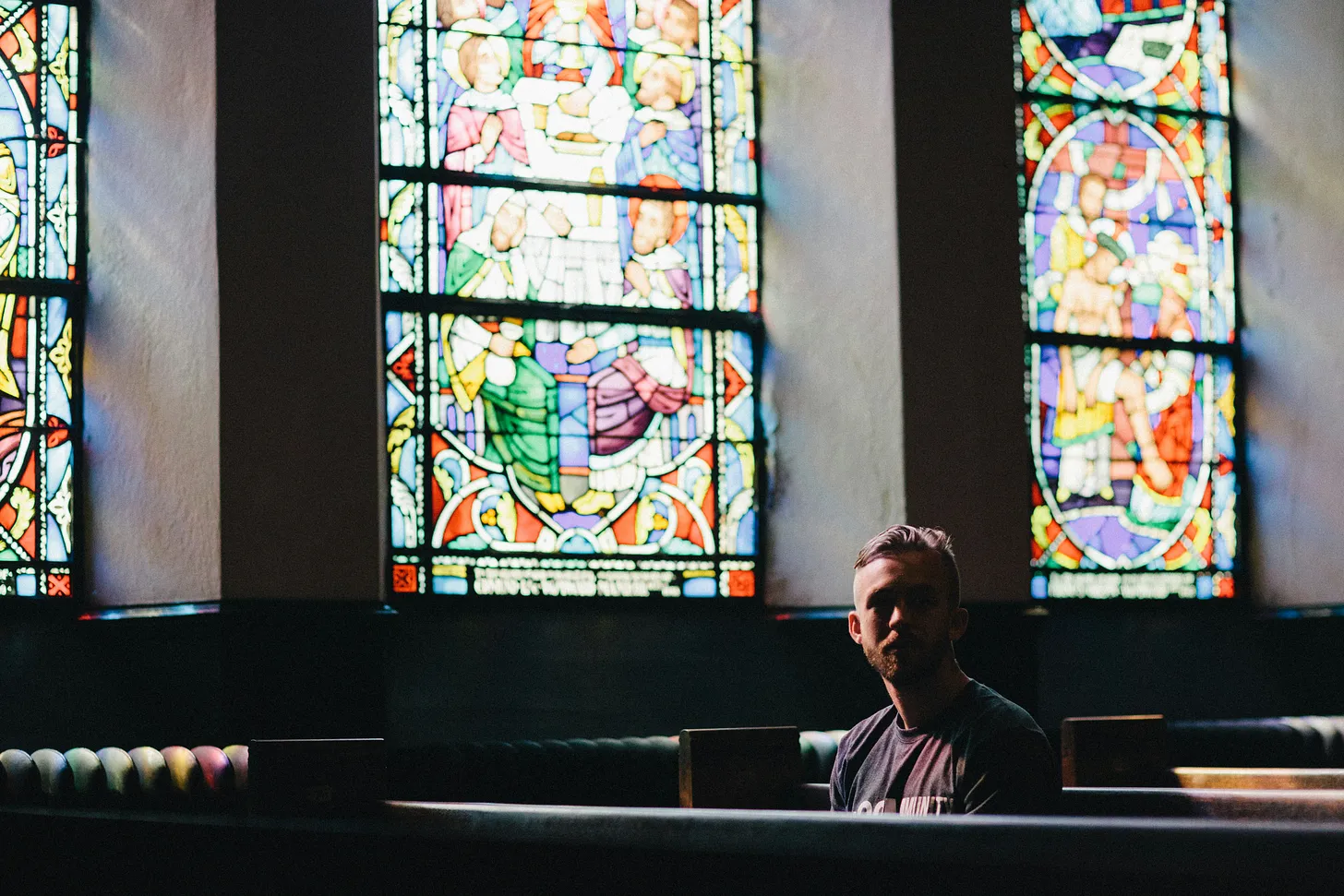
Perhaps God is polite enough to remain hidden.

The idea of a “cloud of unknowing” dates to 14th century mysticism. The concept is not far from the biblical notion that the pure holiness, which we might describe as “God,” defies the paltry human attempt to quantify that which is an ineffable mystery.

In the literary biblical account of Exodus, even Moses only caught a glimpse of YHWH on Mt. Sinai. In Christian theology, the discomfort of being unable to see God is partly remedied by the person of Jesus as God Incarnate. I realize this might not be the universal intellectual solution—even for those who embrace the notion of a Supreme Deity.

Photo by Greg Rakozy on Unsplash

What the *Bleep* Do We Know? is a 2004 American pseudo-scientific film that posits a spiritual connection between quantum physics and consciousness (as part of a belief system known as quantum mysticism). The plot follows the fictional story of a photographer, using documentary-style interviews and computer-animated graphics, as she encounters emotional and existential obstacles in her life and begins to consider the idea that individual and group consciousness can influence the material world. Her experiences are offered by the creators to illustrate the film’s scientifically unsupported ideas (Source: Wikipedia).

With all its limitations, the film effectively illustrates a mystical quality to what might otherwise be seen as purely scientific. Someone has observed that of all of the scientific disciplines, physicists are more apt to possess a spiritual worldview—compared even to biologists!

That the Universe is a vast and elegant mystery seems to be the conclusion of the film. Anecdotally, I was impressed by the exploration of how matter can—and does—appear simultaneously in two different places under controlled laboratory conditions. People of faith have always known the elation that accompanies those epic moments when we realize, however fleetingly, that we cannot contain God, anymore effectively than that we can pour the ocean into a teacup, as Harry Emerson Fosdick once declared.

Humans have struggled with questions about God’s inaction in the face of tragedy. The Book of Job deals with the conundrum that seems to arise when we attempt to reconcile the goodness of God with divine justice. The text seems to teach us that there is no causal connection between goodness in this life and the Divine Favor! Bad things do happen to good people—we all know that.

Theodicy is an attempt to reconcile the existence and nature of God with evidence of evil in the world by providing valid explanations for its occurrence (Svendsen & Pierce, 2010). The Augustinian theodicy (fourth century) asserts that God created the world ex nihilo (out of nothing), but maintains that God did not create evil and is not responsible for its occurrence. (Menn, 2002). Evil is not attributed existence in its own right, but is described as the privation of good— the corruption of God’s good creation.

I long ago jettisoned the notion of ontological evil, i.e. that evil exists apart from our human response to that which might be perceived as evil. Evil does not exist in and of itself, but is always specific in time and space. In this thought process, even the most degenerate individual is not beyond redemption.

The other problem with Augustine’s proposition is that it supports the doctrine of original sin. I have come to deemphasize that in my own theology because I think it leads too easily to the conclusion that we come into the world as damaged goods. I struggle with the language and presumptions of my cherished theological tradition. I have concluded that God loves us not in spite of who we are, but precisely because of who we are. I am willing to rework and reimagine the tenets of my tradition to fit that epiphany.

Archibald MacLeish’s short morality play, J.B., is a retelling of the story of Job. Two members of a traveling circus, Mr. Zuss and Nickles, take up the roles of God and the Devil respectively to test the faith of man. Nickles insists that inordinate suffering must surely cause one to doubt the existence of a benevolent God. At one point, Mr. Nickles lays out the theological quandary:

If God is good, then he is not God, and if he is God, he is not good.

It seems there is no good and satisfactory answer to the problem of evil.

Some theologians have posited that the absence of God is not as much a condemnation as one might think. Some have suggested that God’s absence is perhaps the greatest evidence of God’s existence—it is not an either-or proposition.

So, perhaps God is polite enough to remain hidden—which does not speak to nonexistence—but only to divine prerogative. The cloud of unknowing is vast and sometimes opaque with moments of brilliant presence. I submit that we have each had such a moment.

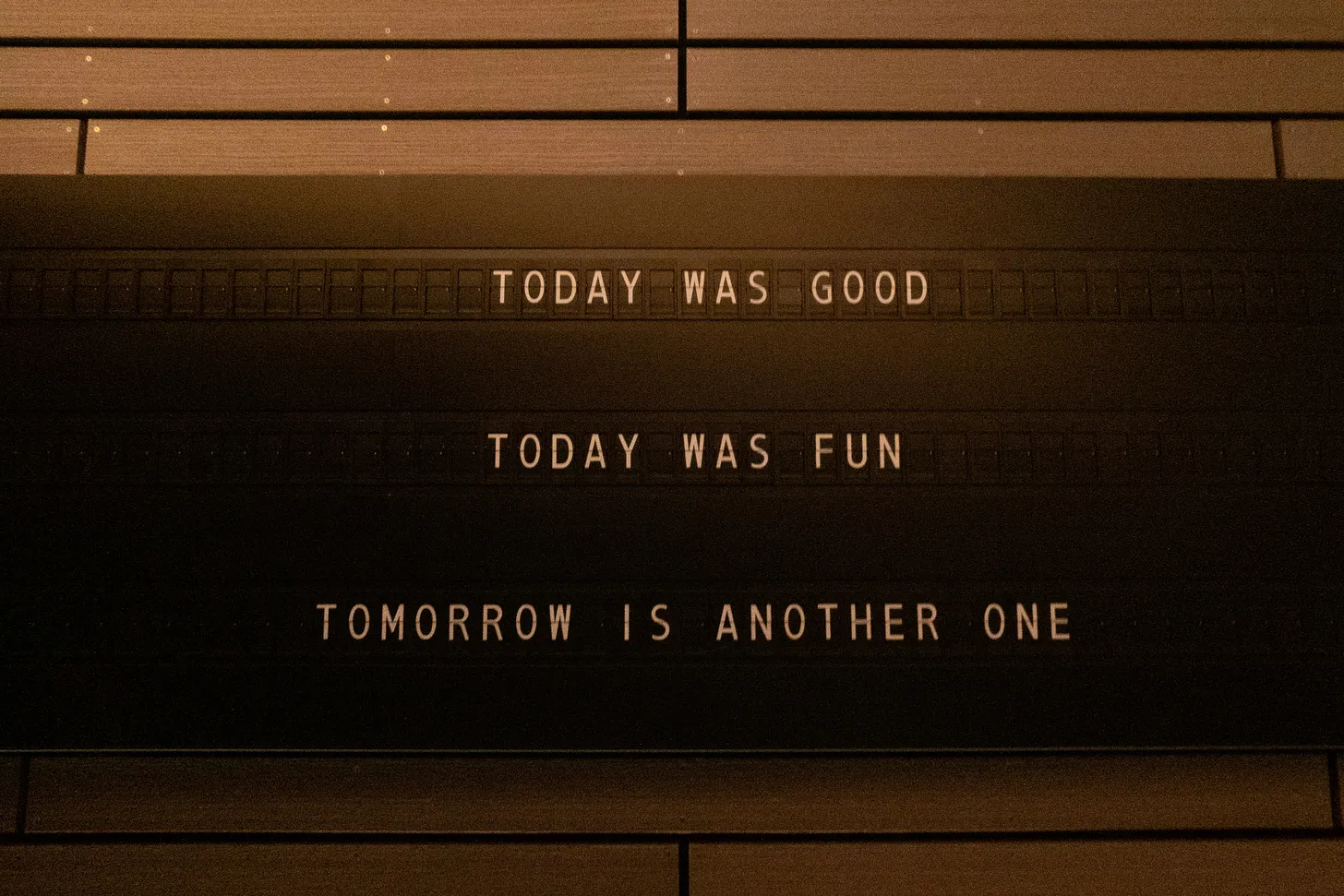
Besides, what the *bleep* do we know?

Thanks for reading Thinking Out Loud! This post is public so feel free to share it.
Leave a comment

Filed under Uncategorized

Godspeed, Mr. President

We mourn both your passing and the loss of America’s promise.

America has entered an era of form over substance, expedience over decency, ignorance over informed debate—and we are impoverished because of it!

When Jimmy Carter told his mother, Miss Lillian, that he was going to run for president, she is said to have asked, “Of what?”

Carter, an unknown Governor of Georgia—and before that a peanut farmer and a U.S. Navy officer—was elected in 1976, defeating incumbent President Gerald R. Ford. Carter was on hospice care for eight months before his death at age 100, making him the longest lived U. S. president in history. He was honored yesterday with a state funeral at the Washington National Cathedral, with all of the living former presidents in attendance, and a cadre of respected clergy officiating. Carter’s beloved wife of 77 years, Rosalynn, died in 2023.

Jimmy Carter, 1924-2024, 39th President of the United States

It was under Jimmy Carter that I became a Democrat—many folks do not know that! Previously—even as a very young man—I would have described myself as a progressive Republican after the example of Michigan Gov. Bill Milliken. I was then and still am personally conservative. Those who thought you knew me, are you surprised? That was at a time when the promise of America burned brightly and seemed to overcome much—but certainly not all—partisanship. I was drawn to public life and thought for a time that I might run for office some day.

The late 60s and early 70s, when I came of age, fell barely three decades after the end of WW II. My dad, my father-in-law, my grandfather—who saw two world wars—and every one of my uncles served. Love of country was a substantive emotion in the minds of most people, even in the midst of that Vietnam thing; I do not wish to minimize the oppositions to that war. The civil rights struggles of that era reached a fever pitch, and only the dullest wit could have missed the obvious conclusion that something new and invigorating was stirring.

There was a collective conviction that the American ideal was genuine and achievable, and I wanted to be a part of that energy. It never occurred to me that the day would come soon in which money would become the medium by which policies are made and human life is degraded under color of law.

My political transition probably began when I matriculated at Wayne State University in the fall of 1969. I promptly joined the College Republicans and attended a few gatherings, where there was always spirited political discussion over a few beers—I was underage at that time, but never had difficulty being served on-campus. All was well, and I was intellectually challenged—until my introduction to Ayn Rand and her philosophy of objectivism. I stopped attending meetings when it occurred to me that what was being celebrated was selfishness over altruism. That was the antithesis of what I had been taught as a Christian disciple, and I simply could not abide that.

By the time Nixon’s crimes had been exposed in the years after Watergate and his disgraceful resignation in 1974, I was thoroughly disappointed in the GOP. I voted for Jimmy Carter in 1976 and again in 1980. Few, if any, pundits have spoken of why Carter lost his reelection bid against Ronald Reagan—and it was nothing short of the reprehensible betrayal of America!

I remember, and so do you, the image of that plane carrying the American embassy hostages taken in Iran on November 4,1979, as it took off on January 20, 1981.

That the Reagan campaign had instigated the holding of the hostages until after he was sworn in is irrefutable—and while it might not rise to the legal definition of treason, it is damned close! With all the coverage about Carter and his presidency, virtually no one has mentioned this treachery. Reagan died without ever being held accountable. Sound familiar? That trend toward normalizing aberrant public behavior—especially prominent vis-a-vis Donald Trump—is a slippery slope that threatens our democratic republic. The worst part is that nobody seems to care.

Which brings me to the present as convicted felon Donald J. Trump is about to be sworn in as president again. What a contrast with the decency of Jimmy Carter!

Both Reagan and Trump enjoyed being the darlings of the religious right, even though neither ever expressed any deeply-held spiritual convictions. Reagan had been divorced and never attended church services. He was estranged from his children and was known to have concocted apocryphal stories to illustrate how the welfare state was the biggest problem in the federal government. His illustrations often evoked dog whistle racism, leading one observer to suggest that Reagan’s greatest talent was in making white people comfortable in their prejudices.

Similarly, Trump has had multiple marriages and apparent instances of adultery. He does not belong to any organized religious institution, and he clearly has no familiarity with the Bible—I thought he appeared uncomfortable when he held up that copy of the scriptures during the BLM demonstration in Lafyette Park in June of 2020. His infamous reference to “2 Corinthians” is at odds with how religiously informed people would refer to that book; his comment was laughable. Trump has repeatedly declined to name his favorite book of the Bible—because he does not know any! He once claimed to be a Presbyterian, which prompted the Stated Clerk of the Presbyterian Church (USA) to announce that there was no evidence of Trump’s membership any PCUSA congregation.

Trump has been found responsible for sexual assault and has openly bragged about such behavior. And then there are those stolen classified documents and the disgraceful insistence that he actually won the 2020 election, despite any credible evidence to support that claim. That was bad enough, but Trump compounded the disgrace when he failed to stop the invasion of the U.S. Capitol before the disgusting events of January 6, 2021, especially the loss of life. His reported callousness about the safety of Vice President Pence on that day shows who he is. Trump is purely and coldly transactional in all of his relationships.

By contrast, Jimmy Carter was married for 77 years, with no hint of marital infidelity. He even Sunday School while he was in office. He was a good and decent man in every way. On the other hand, both Reagan—whose status in right wing circles is almost that of a saint—and the many flaws of Donald Trump—have become preferable in the eyes of many. What a sad realization!

A friend recently asked me why I thought people voted for Trump. He was making the point that Americans were frustrated with the status quo. I reminded him that Trump won the election only because Americans could not comprehend the accomplishments of Joe Biden—a flaw that was enhanced by the reluctance of the media to ask the hard questions. There was no way—if the facts had been known and all things were equal—that Trump would have won! The second disturbing reason has to do with racism and misogamy. Please do not suggest that the victory was in any way pure and unencumbered by widespread lying, the irresponsibility of the news media, and good old fashioned prejudice.

America has entered an era of form over substance, expedience over decency, ignorance over informed debate—and we are impoverished because of it! The high school kid in me weeps for another time.

The affection for Donald Trump—like Reagan before him— from so-called evangelical Christians is legendary. It is, in fact, heretical and has no place in orthodox Christian thought. I fear that the policies of the next four years will be equally as objectionable, and every genuine Christian should oppose them! Jimmy Carter would agree.

Thank you. Mr. President. Rest in peace.

Thinking Out Loud publishes twice weekly on Substack.com and on WordPress at Shalomista.com.. Thank you for supporting my work. Please share these posts widely and consider a subscription. Join the fray with a paid subscription and give me a piece of your mind— or you can always lurk for free! All views expressed are entirely my own and have no connection to any institution of which I might be a member.

Leave a comment

Filed under Uncategorized

On Our 52nd Wedding Anniversary…

…a tribute to marriage.

After all these years, I still choose us!

I have officiated at dozens of weddings in my pastoral career. Each time I stand in the chancel with the communion table behind me, I recall that day when a young woman I thought was out of my league put on a ring I had financed after repeating some words spoken by our good friend and pastor, the Rev. Dr. Robert H. Crilley. I did the same, and voila—we became a married couple.

And here we are—more than five decades later—with two kids, many mistakes and a few victories—along with some medical challenges behind us—and we are still together. I never doubted that for a moment. I believe in marriage, and many folks who have listened to me over the years have shared their perception that my words seem to reflect what I believe. I am both pleased and humbled.

I am not a prude by any stretch, but I am always troubled by those who choose long-term cohabitation over legal matrimony. I do not judge those who choose such an arrangement on purely moral grounds, but I am concerned about the nature of their commitment. If the absence of “a piece of a paper” makes it easier to walk away, what does that say about the resolve to abide in a relationship that is not always glamorous—and frequently challenging? If it is anything, a marriage is the evidence that two people have resolved to join their lives for all the joy and purpose—as well as for the heartache—that such a union brings.

Working in the healthcare field, I have witnessed one partner or the other in an unmarried relationship become completely shut out by a hospital when the other partner is admitted under trauma conditions—and there is no medical power of attorney. I have been known to offer to sign a marriage license without a ceremony for such folks before they get to that critical juncture. Nobody has yet taken me up on my offer. Sadly, I have been around long enough to have seen the very scenario I described come to pass. It is always heartbreaking.

Photo by Denny Muller on Unsplash

We would be mistaken to assert that the Bible ordains the institution of marriage—at least not in the form that we understand it. There have always been betrothals—Mary was betrothed to Joseph—but little is known about anything resembling a wedding ceremony for them or anybody else in the biblical narrative. In ancient Israel, marriage was a covenant between a man and a woman much like the covenant between God and humans. A covenant is a free choice, and it requires daily renewal.

We still use language like that in modern marriages ceremonies. My clergy colleagues and I would just as soon not have to deal with state requirements. Most of us do not like being an agent of the state and would prefer that the wedding take place in the worshiping community independent of any license requirement. That way, it comes closer to being a religious observance than what passes for weddings these days. I have officiated services in a variety of venues outside of the church, but I must confess that I prefer the ceremony that takes place in a hallowed sanctuary. Few weddings take place in the midst of Sunday worship, but honestly, that is where they all ought to be.

Interestingly, marriage was not formalized in the Roman Catholic Church until the late medieval period, with no priestly presence nor vows required (McSheffrey, 2006). The state does not care even today if there is a ceremony or not as long as the proper paperwork is filed by almost any person who pays a fee to be “ordained.” Don’t get me started!

Our wedding was in a very traditional church setting with all the trappings and about 300 attendees. Lorraine and met in a young adult Sunday School class at the historic Fort Street Presbyterian Church in downtown Detroit. As it turns out, our two sons were baptized there, and I got my first preaching experience as a very young man. We both “came of age” in the community, and we were around long enough to have said goodbye to some folks who mentored each of us along the way. I hope I lived down my naivete in those early “sermons.”

The church is first and foremost a community, and it is still the best place to meet one’s future spouse! As luck would have it, I had acquired a respiratory infection the night before the wedding, and so, I was rendered voiceless with laryngitis. We used to have a cassette tape of the ceremony, on which I could be heard barely whispering my “I do!”

We were married on Epiphany, January 6, 1973 because we wanted a Christmas theme. The poinsettias and those hurricane lamps carried by the ladies were beautiful—they worse red or green velvet dresses which complemented the lovely satin wedding gown with that delightful bonnet worn by my stunning bride—it was quite the day!

In the intervening timeframe, there have been challenges to our wellbeing, and now that we are in our seventies, the medical issues become more prominent. I came close to losing Lorraine twice. That was an experience I never want to repeat, although I probably will someday. My final charge to wedding couples often includes an admonition that sounds something like this:

As you stand here today, I remind you that the day will come—hopefully many years hence—when one of you will lay the other in the loving arms of God for the last time. And on that day, I pray that you will be found loving one another as much as you do on this blessed day when it all began! Amen.

After all this time, I still choose us. Happy anniversary, my darling!

Thinking Out Loud publishes twice weekly on Substack.com and on WordPress at Shalomista.com.. Thank you for supporting my work. Please share these posts widely and consider a subscription. Join the fray with a paid subscription and give me a piece of your mind— or you can always lurk for free! All views expressed are entirely my own and have no connection to any institution of which I might be a member.

Leave a comment

Filed under Uncategorized

The Road Less Traveled

The spirituality of inevitability

If we blithely embrace inevitability, we risk acquiescence to much heartache.

Robert Frost’s poem, The Road Not Taken, has been memorized by millions. According to Frost himself, it is mostly misunderstood. At first blush, there seems to be an acknowledgement of the folly of perceived choice, and the romance of inevitability— perhaps we do not actually have a free choice!

That would be an incorrect reading. Humans always have a choice. Merely acquiescing to that which we perceive as inevitable is a mistake of cosmic proportions! Frost’s poem is all about making choices and the courage to be an individual. That mindset might be important—especially in the days to come.

I suspect those themes become critical in a cultural and political milieu where free choice is discouraged and conformity is required. We must beware of any tendency to give up our autonomy because we convince ourselves that the outcome is inevitable.

Two roads diverged in a yellow wood,
And sorry I could not travel both
And be one traveler, long I stood
And looked down one as far as I could
To where it bent in the undergrowth;

Then took the other, as just as fair,
And having perhaps the better claim,
Because it was grassy and wanted wear;
Though as for that the passing there
Had worn them really about the same,

And both that morning equally lay
In leaves no step had trodden black.
Oh, I kept the first for another day!
Yet knowing how way leads on to way,
I doubted if I should ever come back.

I shall be telling this with a sigh
Somewhere ages and ages hence:
Two roads diverged in a wood, and I—
I took the one less traveled by,
And that has made all the difference.

—Robert Frost

Photo by Vladislav Babienko on Unsplash

Frost spent the years 1912 to 1915 in England, where among his acquaintances was the writer Edward Thomas. Thomas and Frost became close friends and took many walks together. One day, as they were walking together, they came across two roads. Thomas was indecisive about which road to take, and in retrospect often lamented that they should have taken the other one. After Frost returned to New Hampshire in 1915, he sent Thomas an advance copy of “The Road Not Taken.” Thomas took the poem seriously and personally, and it may have been significant in his decision to enlist in World War I. Thomas was killed two years later in the Battle of Arras (Source: Wikipedia).

Frost’s friend was known to be indecisive, and the poet was in some ways poking fun at him. The poem is about making hard choices, a basic requirement for navigating one’s life. In a letter to Thomas, Frost wrote: “No matter which road you take, you’ll always sigh, and wish you’d taken another.” Which of us has never entertained the question of “what if?” Perhaps it is far better to dwell in the present moment.

I shall be telling this with a sigh
Somewhere ages and ages hence:
Two roads diverged in a wood, and I—
I took the one less traveled by,
And that has made all the difference.
(The Road Not Taken, 16-20)

Life can be complicated, and I myself have fallen victim to the error that there is only one choice—the right one. There is that notion of inevitability. It is so much easier to yield to that which is bound to happen anyway, but there is no such thing, as if we are simply living out a preordained script. We consider evidence for our decisions and weigh the pros and cons of this action or that one, but there is no pre-existing conclusion to be discovered, even if it were possible to do so.

Making decisions is hard, and you and I always have a choice. We can never know the consequences in advance, and we ought not delude ourselves into thinking that we really do not have a choice because no outcome is inevitable.

But whatever road we take, it will make “all the difference.”

Thinking Out Loud publishes twice weekly on Substack.com and on WordPress at Shalomista.com.. Thank you for supporting my work. Please share these posts widely and consider a subscription. Join the fray with a paid subscription and give me a piece of your mind— or you can always lurk for free! All views expressed are entirely my own and have no connection to any institution of which I might be a member.

Leave a comment

Filed under Uncategorized

The Work of Christmas…

The transformative power of the Nativity

Christmas is a time when the whole world stops to bear witness.

In the Christian tradition, we are still in the season of Christmas. It is only now that “the work of Christmas” has begun, and it is relentless. Our attention is first drawn to the singing of angels. If one listens closely, we can still hear their voices above the faint cries of a homeless baby in a manger.

Howard Thurman was an African-American theologian and preacher who was a mentor to many in the early American civil rights movement.

Photo by Karl Fredrickson on Unsplash

“There must be always remaining in every man’s life some place for the singing of angels – some place for that which in itself is breathlessly beautiful and by an inherent prerogative throwing all the rest of life into a new and created relatedness. Something that gathers up in itself all the freshets of experience from drab and commonplace areas of living and glows in one bright white light of penetrating beauty and meaning – then passes. The commonplace is shot through now with new glory – old burdens become lighter, deep and ancient wounds lose much of their old, old hurting. A crown is placed over our heads that for the rest of our lives we are trying to grow tall enough to wear. Despite all of the crassness of life, despite all of the hardness of life, despite all of the harsh discords of life, life is saved by the singing of angels.

Oscar Wilde says in his De Profundis, “There is always room in an ignorant man’s mind for a great idea.” It is of profoundest significance to me that the gospel story, particularly in the Book of Luke, reveals that the announcement of the birth of Jesus comes first to simple shepherds who were about their appointed tasks. After theology has done its work, after the reflective judgments of men from the heights and lonely retreats of privilege and security have wrought their perfect patterns, the birth of Jesus remains the symbol of the dignity and the inherent worthfulness of the common man.

Stripped bare of art forms and liturgy, the literal substance of the story remains, Jesus Christ was born in a stable, he was born of humble parentage in surroundings that are the common lot of those who earn their living by the sweat of their brows. Nothing can rob the common man of this heritage – when he beholds Jesus, he sees in him the possibilities of life even for the humblest and a dramatic resolution of the meaning of God.

If the theme of the angels’ song is to find fulfillment in the world, it will be through the common man’s becoming aware of his true worthfulness and asserting his generic prerogatives as a child of God. The diplomats, the politicians, the statesmen, the lords of business and religion will never bring peace in the world. Violence is the behavior pattern of Power in the modern world, and violence has its own etiquette and ritual, and its own morality.”


This article is excerpted from Howard Thurman’s The Mood of Christmas and Other Celebrations (Friends United Press, 1985).

Christmas Day has come and gone, but the work of Christmas continues. Its efficacy is up to us who wear the mantle of “Christian.” We do not flaunt it, as some would do. We regard it not as a badge of honor nor as a distinction that sets us apart as being morally superior. On the contrary, we understand that we have been chosen to bear a message of hope, love, mercy, and affirmation to others. We seek to unify, not to divide. Our orientation is not exclusively other-worldly, but rather an awareness that we are partners with God in the repair of a fractured universe.

Genuine Christians see themselves as Christ-bearers, and not as those who wield a sword over humans of a different persuasion. We humbly try to be the presence of the One we call the Prince of Peace to a world very much in need of that word.

It is no secret that I hail from a tradition that honors the Bible as the work of many humans over the centuries, all of whom are attempting to make sense of the world’s history as having meaning precisely because it is God-infused. The Bible does not present a unified message, and that is entirely acceptable. What is does do is to inoculate us against any temptation to sell out to the powers and principalities of this present age because God is the Sovereign Lord of time and space.

The theme of the Bible is antithetical to empire and always oriented to an overarching concern for the poor and dispossessed. The Bible is good news to the downtrodden and a judgment against the oppressors. It is never a manual for those who wish to be only “chaplains for empire” as the Rev. William Barbe of the Poor Peoples’ Campaign has wisely observed. Some of us see ourselves as prophets of God’s justice as we speak truth to power—which is often hard of hearing!

Author Parker J. Palmer reminds us that “2024 was a hard year for millions of people, and the arrival of 2025 will not change that fact. But for millennia, that New Year’s tick of the clock has provided a ritual moment to imagine a more life-giving path into the future.

Howard Thurman—mystic, scholar, and civil rights activist—was no romantic about these things. A black man born in Florida in 1899, he knew all about the cruelties we are capable of inflicting on each other—his beloved grandmother had been an enslaved person. But he never let the hard realities of injustice rob him of the hope embodied in what he called “the growing edge” of our lives.”

All around us worlds are dying and new worlds are being born; all around us life is dying and life is being born. The fruit ripens on the tree, the roots are silently at work in the darkness of the earth against a time when there shall be new lives, fresh blossoms, green fruit. Such is the growing edge! It is the extra breath from the exhausted lung, the one more thing to try when all else has failed, the upward reach of life when weariness closes in upon all endeavor. This is the basis of hope in moments of despair, the incentive to carry on when times are out of joint and men have lost their reason, the source of confidence when worlds crash and dreams whiten into ash. The birth of a child — life’s most dramatic answer to death — this is the growing edge incarnate. Look well to the growing edge!
—Howard Thurman, The Growing Edge

The work of Christmas continues. It encourages us in times of challenge—ever reminding us that we owe our devotion only to the High and Holy One—and not to any temporal authority. It calls us to seek the sacred in the simple and unassuming.

The days will come, and they will go. Look well to the growing edge, and do not be afraid!

Thinking Out Loud publishes twice weekly on Substack.com and on WordPress at Shalomista.com.. Thank you for supporting my work. Please share these posts widely and consider a subscription. Join the fray with a paid subscription and give me a piece of your mind— or you can always lurk for free! All views expressed are entirely my own and have no connection to any institution of which I might be a member.

Leave a comment

Filed under Uncategorized

Coventry Carol 2024…

If we only knew.

Dark lyrics ought to give us pause in the present day…

Many Christians sing the Coventry Carol without thinking much about the lyrics. The subject matter is quite dark and not at all “Christmasy.” It often appears as a worship hymn suggestion at the beginning of the calendar year, that is, after Christmas.

For those who read the Nativity Story sequentially, the account of what is often called “the slaughter of the innocents,” occurs at this point. It is the grim story of King Herod’s attempt to eliminate his competition for kingship by ordering his soldiers to kill all the male Jewish children who are two years old and under. That way, he is sure to include this newly born King of the Jews, about which the Magi had told him.

It is here that the chronology becomes a little confusing. For one thing, the three kings did not make an appearance for two years—it took them that long to travel to Herod’s locale—so the depictions of the Wise Men at the stable are clearly anachronistic; they were never there! There are other textual difficulties, but they are unimportant here.

But killing children is never palatable, but perhaps it can be rationalized—especially if a greater personal right is at stake. Of course, I am speaking of the dubious “right to bear arms,” as articulated in the Second Amendment. We seem to ignore all the others, as well as the wisdom of our founding document reminding us of the right to “life, liberty, and the pursuit of happiness.”

Photo by Julian Gentile on Unsplash

I will never forget where I was on December 14, 2012. I was sitting in a large Masonic convocation in Detroit when I received a text alert on my cell phone informing me of the tragedy at Sandy Hook Elementary School in Newtown, Connecticut.

The perpetrator, 20-year-old Adam Lanza, shot and killed 26 people. The victims were 20 children between six and seven years old, and 6 adult staff members. Earlier that day, before driving to the school, Lanza fatally shot his mother at their Newtown home. As first responders arrived at the school, Lanza killed himself with a gunshot to the head. (Source: Wikipedia).

Those children, first graders, would have graduated high school this past spring. Some of them would have started college. Besides the horror of the news, I remember thinking that America at last would not tolerate the murder of 20 precious children. I was wrong because virtually nothing has been done to stem the gun violence. This was not the first school shooting—sadly, it would not be the last.

We blithely sing the words of the Coventry Carol in Christian worship:

Lully, lullay, thou little tiny child,
Bye bye, lully, lullay.
Thou little tiny child,
Bye bye, lully, lullay.

O sisters too, how may we do
For to preserve this day
This poor youngling for whom we sing,
“Bye bye, lully, lullay?”

Herod the king, in his raging,
Chargèd he hath this day
His men of might in his own sight
All young children to slay.

That woe is me, poor child, for thee
And ever mourn and may
For thy parting neither say nor sing,
“Bye bye, lully, lullay.”

My wife and I were having drinks with friends on another occasion ten years later when the television news reported yet another school tragedy involving guns and death. “Nineteen children and two adults were killed in a shooting at Robb Elementary School in Uvalde on May 24, 2022. It is the deadliest shooting ever at a Texas public school.” (Source: The Texas Tribune). I could hardly believe what I was seeing.

As more information about the incident was received, it became obvious that local officials had botched the response and had allowed the shooter to take even more life because of the hour-long delay before confronting him. Later evidence would establish that the police failure was nothing short of the dereliction of duty.

The words of the dark carol ought to give us pause. Instead, the legislative and policy dialogue—to the extent that there is any—involves inordinate concern about the perceived right of ordinary citizens to purchase and employ whatever firearms they want—because they have the right. Hogwash! The argument is both legally and intellectually dishonest. And even if that argument were true, common sense demands an effective system of background checks.

The sad truth is that my initial belief that America would not tolerate such carnage has proven false several times over since 2012. Several politicians have offensively suggested that we just need to “get over” such tragedies.

We have not held any of policy-makers responsible for their immoral inaction, and still we sing:

That woe is me, poor child, for thee
And ever mourn and may
For thy parting neither say nor sing,
“Bye bye, lully, lullay.”

Perhaps we deserve what we have wrought. Lord, in your mercy…

Thinking Out Loud publishes twice weekly on Substack.com and on WordPress at Shalomista.com.. Thank you for supporting my work. Please share these posts widely and consider a subscription. Join the fray with a paid subscription and give me a piece of your mind— or you can always lurk for free! All views expressed are entirely my own and have no connection to any institution of which I might be a member.

Leave a comment

Filed under Uncategorized

O Holy Night…

…the peaceful power of Christmas.

Holiness does not imply perfection, but the sanctity of being set apart for a sacred purpose. The night to come is to be venerated because it is truly holy!

In the fall of 1843, a French wine merchant, Placide Cappeau, was asked by his local priest to write a Christmas poem. Not long after, Placide Cappeau showed his poem, “Minuit, chrétiens,” to the famed French composer, Adolphe Adam, and within a few days Adam had composed a musical setting for it. [Source: Wikipedia].

The song quickly became popular in the English-speaking world when John Sullivan Dwight wrote the English version, O Holy Night [Source: David Issokson, Frenchlearner.com]. It is not an easy song to sing, but it has a haunting quality about it.

I have officiated at my share of Christmas Eve worship services where this beloved hymn was sung, usually as a solo. It never ceases to captivate me when I hear it. I especially need to bask in its beauty this year, and when I do, I will no doubt experience something of the peace that will propel me into an uncertain future. Like many folks, I am more than a little apprehensive about that at the moment.

The theme is easy to identify; this is a carol that seeks to establish a clear delineation between the time before the birth of the one we have come to call “the Christ” and the human condition that exists after the blessed event. The move toward repair of a universe, which is fractured, is made possible by the will of God, and not by human endeavor.

I am aware that some who read this will not comprehend this story as I do. I ask only that you stop to appreciate the undisputable fact that the life of one man has had a monumental effect on the unfolding of history since the dawn of the first century of the Common Era. Suspend, for the moment, any assertion that he never existed in time and space. Do not be put off by the myth of the Virgin Birth—resisting the temptation to confuse theology with gynecology, as Frederick Buechner has suggested. It rarely pays to get lost in the artistic intricacies of an epic narrative. One runs the risk of missing the truth that is conveyed.

Sometimes, we need to let the music and the words speak to us:

O Holy Night!
The stars are brightly shining
It is the night of the dear Savior’s birth!
Long lay the world in sin and error pining
Till he appear’d and the soul felt its worth.
A thrill of hope the weary soul rejoices
For yonder breaks a new and glorious morn!

Fall on your knees
Oh hear the angel voices
Oh night divine
Oh night when Christ was born
Oh night divine
Oh night divine

Photo by Hongwei FAN on Unsplash

Resist also the error that the Jewish narrative, in which the Christ event is enmeshed, suggesting that the experience of God’s Covenant people has nothing to teach us in this moment. On the contrary, the message of the ancient prophets first comes in the midst of travail—in captivity—in which the people of God (Israel) live in exile, all the while being exhorted to not lose hope in the moment of a prophesied transformation that will surely come. O Holy Night gives us a glimpse of that cosmic promise that humans will survive and be blessed.

A thrill of hope the weary soul rejoices For yonder breaks a new and glorious morn!

I don’t know about you, but I get rather weary sometimes—it seems that hatred and greed and violence have dominated for far too long. The careful observer of politics and social phenomena will be disturbed by the ways in which the previously unthinkable is now becoming acceptable. Rhetoric that was once objectionable in anybody’s mind is slowly being “normalized.” It is the way fascism starts—just ask the Germans of the 1930s. That is our specific experience—the truth is that life on this planet has always been difficult and full of travail.

Cappeau’s poetry captures that darkness and holds it up to the light of God’s redemption, which is ushered in by the events of one truly holy night. From that moment forward, history is invaded—and its trajectory is forever altered. For Christians, the miracle is no so much in the how, but it is deeply embedded in the why.

And even for those for whom the Nativity narrative is not especially instructive, there is something powerful going on here:

“Then an angel of the Lord stood before them, and the glory of the Lord shone around them, and they were terrified. But the angel said to them, ‘Do not be afraid, for see, I am bringing you good news of great joy for all the people: to you is born this day in the city of David a Savior, who is the Messiah,the Lord. This will be a sign for you: you will find a child wrapped in bands of cloth and lying in a manger.’And suddenly there was with the angel a multitude of the heavenly host, praising God and saying,

‘Glory to God in the highest heaven,
and on earth peace among those whom he favors!’”

—Luke 2:8-14, NRSVUE

O Holy Night leads us into the beauty of a moment when human history was no longer just a series of tragic events, but was now the nexus between heaven and earth. People of faith celebrate this as the reality of “God with us.” And many of us would stake our very lives on that truth, which is the peaceful power of Christmas.

Thinking Out Loud publishes twice weekly on Substack.com and on WordPress at Shalomista.com.. Thank you for supporting my work. Please share these posts widely and consider a subscription. Join the fray with a paid subscription and give me a piece of your mind— or you can always lurk for free! All views expressed are entirely my own and have no connection to any institution of which I might be a member.

Leave a comment

Filed under Uncategorized

The Good King…

Is there such a thing?

For the first time in our 258-year history, America might be getting a king, and there is no such thing as a good king!

I find the historical development of monarchy fascinating, and being the Anglophile that I am, I am especially captivated by the customs of the British Crown. My DNA is three-quarters English, Northern Irish, with a little Scottish thrown in for good measure. I also have a bit of Danish, which is not surprising, given the shared history of Great Britain and Scandinavia in the 9th to the 11th centuries.

We might be indebted to the ancient Norsemen for passing down the notion of a “good king.” In the opening lines of the Old English poem, Beowulf—set in 5th-6th century pagan Scandinavia and probably written down closer to 1000 CE— we are introduced to Scyld Scéfing, a man known for violence against his enemies, and his gifts of treasure to his friends, a man of whom the poet says þæt wæs gód cyning (that was “a good king”). [Source: Kingship in the Viking Age – Icelandic Sagas, English Kingship, & Warrior Poets (December 14, 2024]. Prior to the Norman Invasion of 1066, England was ruled by a Danish king known as Canute the Great. Those of us with English heritage know why we carry Danish DNA.

The Norsemen evidently recognized something akin to “the divine right of kings,” which British monarchs wholeheartedly embraced from an early age of the institution. Of course, that notion existed long before the Middle Ages—the ancient Israelites knew something about that, too.

When the Israelites clamored for a king, YHWH reminded them that their desire was superfluous. In 1 Samuel 8, the people of Israel ask the prophet to set a king over them, that they be “like other nations.” Up to this moment, there had been no monarch; it was understood that YHWH was the only king they needed. But the people persisted.

Upon instructions from the LORD. Samuel tries to warn them of their folly.

So Samuel reported all the words of the Lord to the people who were asking him for a king. He said, “These will be the ways of the king who will reign over you: he will take your sons and appoint them to his chariots and to be his horsemen, and to run before his chariots, and he will appoint for himself commanders of thousands and commanders of fifties and some to plow his ground and to reap his harvest and to make his implements of war and the equipment of his chariots. He will take your daughters to be perfumers and cooks and bakers. He will take the best of your fields and vineyards and olive orchards and give them to his courtiers. He will take one-tenth of your grain and of your vineyards and give it to his officers and his courtiers. He will take your male and female slaves and the best of your cattle] and donkeys and put them to his work. He will take one-tenth of your flocks, and you shall be his slaves. And on that day you will cry out because of your king, whom you have chosen for yourselves, but the Lord will not answer you on that day.”

—1 Samuel 8:10-18 (NRSVUE)

Photo by Gvantsa Javakhishvili on Unsplash

Elsewhere in the Old Testament, specifically in Deuteronomy 17, the obligations of the “good king” are outlined:

“When you have come into the land that the Lord your God is giving you and have taken possession of it and settled in it, and you say, ‘I will set a king over me, like all the nations that are around me,’ you may indeed set over you a king whom the Lord your God will choose. One of your own community you may set as king over you; you are not permitted to put a foreigner over you, who is not of your own community. Even so, he must not acquire many horses for himself or return the people to Egypt in order to acquire more horses, since the Lord has said to you, ‘You must never return that way again.’ And he must not acquire many wives for himself or else his heart will turn away; also silver and gold he must not acquire in great quantity for himself. When he has taken the throne of his kingdom, he shall write for himself a copy of this law on a scroll in the presence of the Levitical priests. It shall remain with him, and he shall read in it all the days of his life, so that he may learn to fear the Lord his God, diligently observing all the words of this law and these statutes, neither exalting himself above other members of the community nor turning aside from the commandment, either to the right or to the left, so that he and his descendants may reign long over his kingdom in Israel.”

—Deuteronomy 17:14-20 (NRSVUE)

The careful reader will note that most of the kings of Israel failed to conform to those standards. Some, like Ahab, were downright apostate. Remember Queen Jezebel? A good friend and mentor says that the very institution of the Israelite kingship was a dismal failure! I tend to agree. Keep in mind that Deuteronomy appears chronologically after the unfortunate experiences with some of the most flagrant offenders who have sat on the throne. Think of the opulence of Solomon and his myriad wives and concubines (cf v. 17)! Solomon’s life does not come close to meeting the standard set down in Deuteronomy 17. Still, Solomon is a beloved king!

Historically, the institution of monarchy did not begin with anything as complex and nuanced as the British royalty—some say it is an anachronism, which has outlived its usefulness. I will not weigh in on that matter since it really does not concern me as an American. It took centuries for the Briskish monarchy to evolve. To be fair and accurate, Great Britain’s government performs within the framework of a constitutional monarchy where “the Crown” is little more than a figurehead, but still, all lawful policies must be blessed by the monarch or they are not implemented. This differs widely from the monarchies of the Arab world, which are a bit more absolutist, and some are religiously mandated.

To be sure, there have been strong monarchs and weak ones, kind ones and cruel ones—kings or queens who were progressive and wise, while others were either dullards or morally dissolute—or both. They all ascended from a position of strength, dating back to the first rulers who had the largest army or the who controlled the most real estate.

But the reality of a benevolent king is mostly a myth.

A king—any king—sits on a throne which is the very symbol of governance by domination. He often got there because he inherited the title, and he reigns for the rest of his natural life; he ceases to rule only when he dies. There are no opportunities for his subjects to weigh in on his policies. His word is final on all matters, and there are no “guardrails” against aberrant behavior. There are no provisions for impeachment.

The king may or may not be of an amiable disposition, which might lead to some reform. One thinks of the plot to assassinate Queen Victoria in 1842. The plotter fired at her but missed. He was subsequently convicted of treason, which carried the barbaric penalty of hanging, drawing, and quartering. The queen commuted his sentence to banishment for life, citing a desire that her reign should be more humane. She could have just easily accepted that cruelty was part of being a leader. Thankfully, she did not.

I am aware of those who suggest that Mr. Trump’s moral behavior—objectionable as it might be—is really sort of “Davidic.” If that observation is tied to the assertion that he is God’s chosen—well, count me as a no vote. But then, I distress, but only a little.

When the Founders were pondering the sort of government América might have, a monarchy was considered—and rejected. And so it was. The problem with the king—or queen—is that entitlement to authority that derives from something other than the consent of the governed is inherently flawed. It often deuterates into tyranny.

In the Bible, the apostasy of the Israelites in “clamoring” for a king was a rejection of the covenant relationship between the people and YHWH—the proper name of Israel’s God. Their security had always been centered in that relationship. But now, they were to be subjected to the whims of flawed humans. Their history from that point forward was to become regrettable.

The man who is to become president next month has been enabled by a dubious Supreme Court ruling that effectively makes him a king. It would be a mistake to ignore the dangers in that. History shows there is no such thing as a “good king.”

Thinking Out Loud publishes twice weekly on Substack.com and on WordPress at Shalomista.com.. Thank you for supporting my work. Please share these posts widely and consider a subscription. Join the fray with a paid subscription and give me a piece of your mind— or you can always lurk for free! All views expressed are entirely my own and have no connection to any institution of which I might be a member.

Leave a comment

Filed under Uncategorized

I’m Dreaming of a White Christmas…

The power of the mythic past.

I was born and raised in a delightful city on the Ohio River. Huntington, WV was founded in 1871 and named for railroad magnate, Collis P. Huntington. It was established as the western terminus of the Chesapeake and Ohio Railroad. Our town had quaint brick streets, lots of trees, and a fair number of churches. The sound of steeple bells could be heard all across town on Sunday mornings.

It was a great place to live and had a certain charm at Christmas time. Our town of about 83,000 was just big enough to have the feel of a much larger city with the two major department stores and dozens of smaller shops open and thriving during the holiday season. We lived in the west end, so going shopping was “uptown” for us—only a 20-cent bus trip. If you were in a hurry, you could get a cab right to the door for maybe a buck. Huntington was a great place to come of age.

My neighborhood was always decked out for Christmas, and I remember fondly being dispatched by my grandmother to walk a couple of blocks to buy holly from Mrs. Ice’s huge tree in her front yard. I paid for the greenery with the half dollar my grandmother had given me. That annual ritual lives in my memory.

I remember decorative window stencils, which were big in those days. We would create various images—candles, bells, angels, Christmas trees—using the cut-outs and a product known as glass wax. “Snow” from a spray can was liberally applied as well. It was all rather “low-tech” compared to the present day, but the experience was delightfully tactile and powerfully affirming to a kid like me. I always had the feeling that what was going on around me in the month of December was all-encompassing. I can’t help but yearn for that seminal time in my life—a time when I learned something of what it means to live as a responsible and contributing member of a community.

My family could be described as lower middle class, I suppose. We never had much money, and essentials, like school clothes, were not easy to come by. I sensed at an early age that Christmas was an especially tense time for my parents, who always did the best they could. Still, the image of the idyllic Christmas, whether or not it ever actually existed, is palpably present in my memory. Christmas might never have been perfect when I was a kid, but it came close!

Right about now—like many folks— I’m dreaming of a white Christmas. I cannot say just how many of my past Christmases actually were white—I suspect it was fewer than a third—but the psychic image is nonetheless compelling. The mythic past, you see, is a very powerful thing. It drives our collective memory, to which we all contribute in our own minds. It matters not that what we recall may or may not have taken place. Everybody knows what we mean when we speak of a “white Christmas.” And to think that the beloved song was composed by a man who did not celebrate the holiday—Irving Berlin was Jewish!

Photo by Bank Phrom on Unsplash

Berlin lost an infant son on Christmas Day in 1928. Every year, Berlin and his wife visited their son’s grave on Christmas. Some have noted that the lyrics are a bit more somber than some of Berlin’s other compositions, and the song may well have been one way the songwriter coped with his son’s death, according to his daughter, Linda Emmett in a 2000 interview. (Source: American Songwriter).

I’m dreaming of a white Christmas
Just like the ones I used to know
Where the treetops glisten
And children listen
To hear sleigh bells in the snow

The theme is purely nostalgic and not at all religious. And every one of us knows what the words mean to each one of us. The evocation of a collective memory of goodness is wedged in our conscious thought processes. It reminds me of playing cowboy in the snow with my cousins on Christmas Day, and the smell of exploding gunpowder from the rolls of “caps” we used in our toy six-shooters, and it was all glorious!

After Christmas was over, and while we were still on break from school, my friends and I would comb the neighborhood for the discarded Christmas trees, and we would build a huge fort that probably lasted about a week before we were forced to dismantle that defensive structure. How precious are those memories of brotherhood and just plain fun! It was like one of the characters says in the film Stand by Me, speaking nostalgically, “You’ll never have a friend like you had when you were 12 years old.” I know how true that is.

It is neither accurate nor fair to suggest that the mythic past is illegitimate. It is that very recollection—factual or not— that drives our collective social narrative. It’s what causes us to yearn for that special “white Christmas” when life was simpler and our love for one another was what inspired us. Maybe it’s all about love.

Thinking Out Loud publishes twice weekly on Substack.com and on WordPress at Shalomista.com.. Thank you for supporting my work. Please share these posts widely and consider a subscription. Join the fray with a paid subscription and give me a piece of your mind— or you can always lurk for free! All views expressed are entirely my own and have no connection to any institution of which I might be a member.

Leave a comment

Filed under Uncategorized

Tomorrow, and tomorrow, and tomorrow…

The celebration of dailyness…

“Tomorrow, and tomorrow, and tomorrow,
Creeps in this petty pace from day to day,
To the last syllable of recorded time;
And all our yesterdays have lighted fools
The way to dusty death. Out, out, brief candle!
Life’s but a walking shadow, a poor player
That struts and frets his hour upon the stage,
And then is heard no more. It is a tale
Told by an idiot, full of sound and fury,
Signifying nothing.”

—William Shakespeare, Macbeth

Nothing but experience can prepare one for the daily grind of any enterprise. Even the most exhilarating profession has its moments of mindless routine. Just ask any first responder, who often endures hours of boredom followed by moments of sheer terror. They will tell you that the unpredictability is what entices them to their work—as well as being the reason for their burnout and fatigue.

Poet Stanley Kunitz was a bit more sanguine about the subject when he wrote, “It is out of the dailiness of life that one is driven into the deepest recesses of the self.” It seems there is a certain drudgery attached to the per diem routine that often militates against the elegance of one’s chosen vocation. We take demonstrable note of it only when we feel particularly stressed or challenged—at those moments when are likely to consider ourselves ill-used. Perhaps we need to pay closer attention.

The truth is, as C. S. Lewis has reminded us, “The future is something which everyone reaches at the rate of 60 minutes an hour, whatever he does, whoever he is.”

Photo by Nick Fewings on Unsplash

One day follows another in the experience of most of us. and often, there is northing notable transpiring in any given 24-hour period. Right now, in the late autumn, when the days are just beginning to remind us that sunshine does not grace us every day, we might become discouraged by the early nightfall; it will only become more pronounced by the middle of December. We will still be here when winter actually begins, and we will trudge thought the snow to go about our daily business. Most—but not all of us—will make it to the Spring Solstice. And some—but not all of us—will come to realize that the passing of the seasons has nothing to do either with our will or our pleasure.

“All is vanity,” says the Preacher, and so it is. Ultimately, there is a season for everything—the good and the bad. A place and time for all things under the sun. Tempus fugit, whether we like it or not!

In the 21st century—deep into an age of science that has advanced to an understanding of quantum mechanics and particle physics (not for me!), we blithely speak of the space-time continuum. A rudimentary knowledge of black holes might give us some idea of energy and matter folding in on itself. For the first time since Einstein’s Theory of Relativity, the average person is passably familiar with the notion of time that is markedly different from the poetic perspective of the ancient psalmist when he declares, “A thousand ages in thy sight are like an evening gone” (Psalm 90). The elegance of that acknowledgment exceeds the human capacity to grasp unadulterated awe!

In the Western perspective, time is often regarded as a commodity—and a scarce one at that. It is almost as if time itself is devoid of any meaning, apart from its utility. But what if time actually does possess an intrinsic quality that exceeds even its obvious value? What if we were to perceive time as having been infused with meaning since its beginning nearly 14 billion years ago? Indeed, the ancient Hebrews understood that perspective, and the same orientation has been coopted by Christians and Muslims.

As a pastor and worship leader, I am amused by those who appear for worship just before the appointed time has actually begun. The same observation might be made about the worker who shows up at her work station precisely at the moment when her employment clock begins to record. I have a dear friend and colleague who used to say that such behavior was a product of an industrial society wherein we have learned to withhold our work (devotion) until the time clock is activated! I think there is some truth to that.

It is often said that time flies when we are having fun. I always add that it does even if we are not! For Christians, this is the Advent season, and it is a time of expectant waiting based on the experience of the past and the extrapolation that what has already happened will happen again. There was a first coming [of Christ] in the past; there will be another…and another…and another, and so forth…

More to the point, the Prince of Peace has come and will keep coming. And none of it has anything to do with human agency! Meanwhile, we are to find meaning in the dailyness of life—even when it threatens to degenerate into a mind-numbing routine. I suspect it has something to do with the intentional veneration of time as the sacred gift it is.

Thinking Out Loud publishes twice weekly on Substack.com and on WordPress at Shalomista.org. Thank you for supporting my work. Please share these posts widely and consider a subscription. Join the fray with a paid subscription and give me a piece of your mind— or you can always lurk for free! All views expressed are entirely my own and have no connection to any institution of which I might be a member.

Leave a comment

Filed under Uncategorized