
Second Sunday in Lent
Genesis 17:1-7, 15-16; Mark 8:31-38
The Detroit faith community in which I came of age always received a special offering on Palm Sunday. As a Lenten discipline, folks were asked to take home a Lenten self-denial coin folder with slots into which one would insert a quarter each day of the week. At the end of Lent, the folders were collected for the One Great Hour of Sharing appeal.
Even as a very young man, the amount of money set aside each day never seemed especially burdensome, but there was something about the exercise that I liked. Perhaps it was the familiarity of it year after year that I came to appreciate. And it was a community exercise, which that made it even more special.
I recall the sheer weight of a full folder, and there was something about the sight of all those quarters representing some level of daily sacrifice. It seemed as though I had accomplished something good as I beheld all of those quarters lined up and firmly fixed in their slots. I’m not certain I completely understood the concept of self-denial, but it felt important that we all should participate. It was always a satisfying moment when I was able to enter the narthex and deposit my folder in the receptacle designed for that purpose.
As I think about my own faith development, it seems that my most profound spiritual experiences have come in the context of the faith community. Even now, the strains of an old familiar hymn often evoke a deep memory that I cannot easily describe, but which causes to well up within me a profound sense of affirmation. It’s like the emotion one might experience when returning home after a long absence.
Like all of us, I am the sum of all the nurture I with which I have been graced from the beginning of my Christian journey. We need the love, the affirmation, the discipline—and sometimes even the reproof—of our Christian community to be faithful disciples.
Like Abraham and Sarah, who are called at a very advanced age to get up and move to another place, maybe we risk not living with a sense of God’s presence when we opt for the safer course of action by staying where we are, where everything is safe and predictable. What if the genuineness of our vocation is discoverable only when we deny ourselves by relinquishing our self-maintained security in favor of our call to live in relationship with God and each other? I’ll connect the dots in a moment.
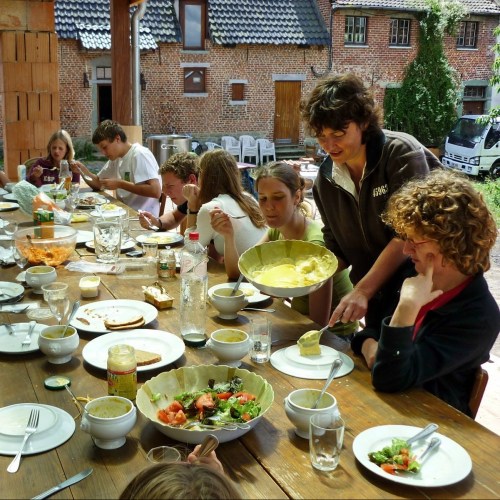
Abraham and Sarah could have remained there—just the two of them—or they could have (and did) rely on the divine promise that there would be many more human relationships that just might help them see God. It’s all about living in blessed community. We are better together.
Truth be told, most of us don’t do self-denial very well. It goes against our own sense of worth and may leave us wondering if there is any genuine value in it. And yet, Jesus himself makes it plain:
He called the crowd with his disciples, and said to them, “If any want to become my followers, let them deny themselves and take up their cross and follow me…”
On the surface, Jesus admonishes his disciples to give up their unique identities, but I wonder if that is what he means. Perhaps, as Prof. Karoline Lewis of Luther Seminary suggests, there is a slightly different interpretation. What if the denial of which Jesus speaks is less about self-deprivation and more about our making an intentional choice to be in community, thereby discovering the essence of who we are?
Perhaps our true identity becomes apparent—and spiritually operative—when we live as an organic whole. That does not mean that we cease to be who we are as individuals, but it does suggest that we need each other and that we are better together.
In the 1830s, about a generation and a half before this congregation was founded, the French diplomat Alexis de Tocqueville visits the comparatively new country of America and is impressed with the propensity of Americans to be “joiners.” The local Grange was a center of communal life, and churches enjoyed a heyday of membership. Just a century and a half later, the contributors to the 1984 book Habits of the Heart conclude that the prevailing ethos of rugged individualism—which was always present—had become that reality which militates against the very sense of community that once made America strong.
One could argue that the 1980s decade in America was the beginning of our tacit acceptance of a mindset of “I’ve-got-mine-let-them-get-theirs.” It’s hard to argue with the many public policies enacted in the 80’s and 90s that seem to demonize the poor and legitimizes the status quo.
Abraham and Sarah would have known nothing of Trinitarian theology, and yet, their obedient response to God’s bidding was born of the same spiritual considerations. As I understand it, the relationship between the three separate persons of the Godhead is a mandate for humans to live in a similar indivisible relationship. What would have happened had they not obeyed? No divine relationship, no community, no blessing. Just an aging couple all on their own.
We need each other.
Jesus also connects the necessity of denying ourselves with the mandate to take up our respective crosses. What do you think he means by that? How often have you heard someone say, in commenting on some personal burden, (perhaps you have said it yourself!) “I guess it’s just my cross to bear?” That’s not a cross…it’s an unfortunate burden! No, when Jesus speaks of a cross, he is talking about that which we intentionally take up for the sake of the Kingdom of God!
Lent is all about the sort of reflection that moves us to that place—that self-discovery—where we may begin to understand our unique role in repairing Creation—in building the Kingdom right here and right now. Taking up our cross is part and parcel of that mandate to claim our vocation. That all seems to work best in the context of a community where each of our unique gifts are discovered, affirmed, and celebrated.
The call to deny ourselves does not mean that we give up our individual identities, but rather that those identities become part of the blessed whole. We become the sum of God’s redemptive motivation as we look toward the coming of the Kingdom in its completed glory. Until then, we exhibit to the world what the Kingdom looks like. We need each other for the tapestry to be complete!
May this holy season find us in discernment as to how we each might become part of God’s divine solution to the otherwise fractured world in which we live. We need each other.
 Raising Basileia